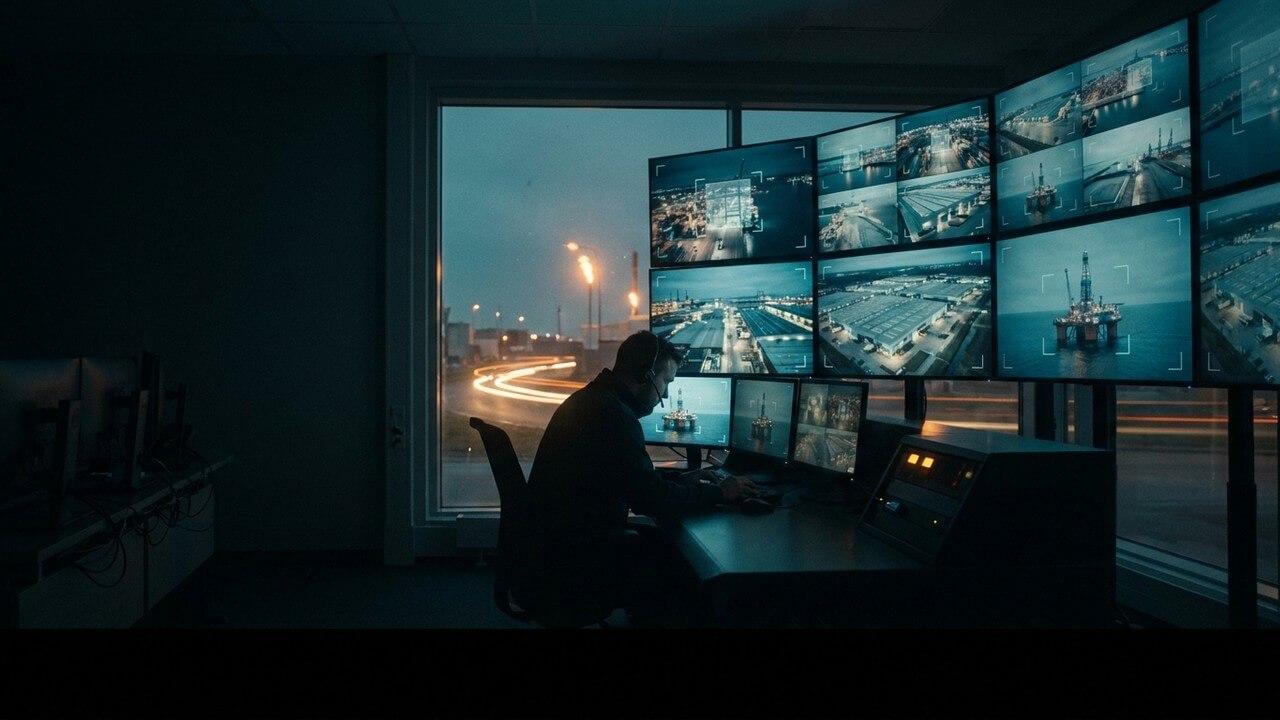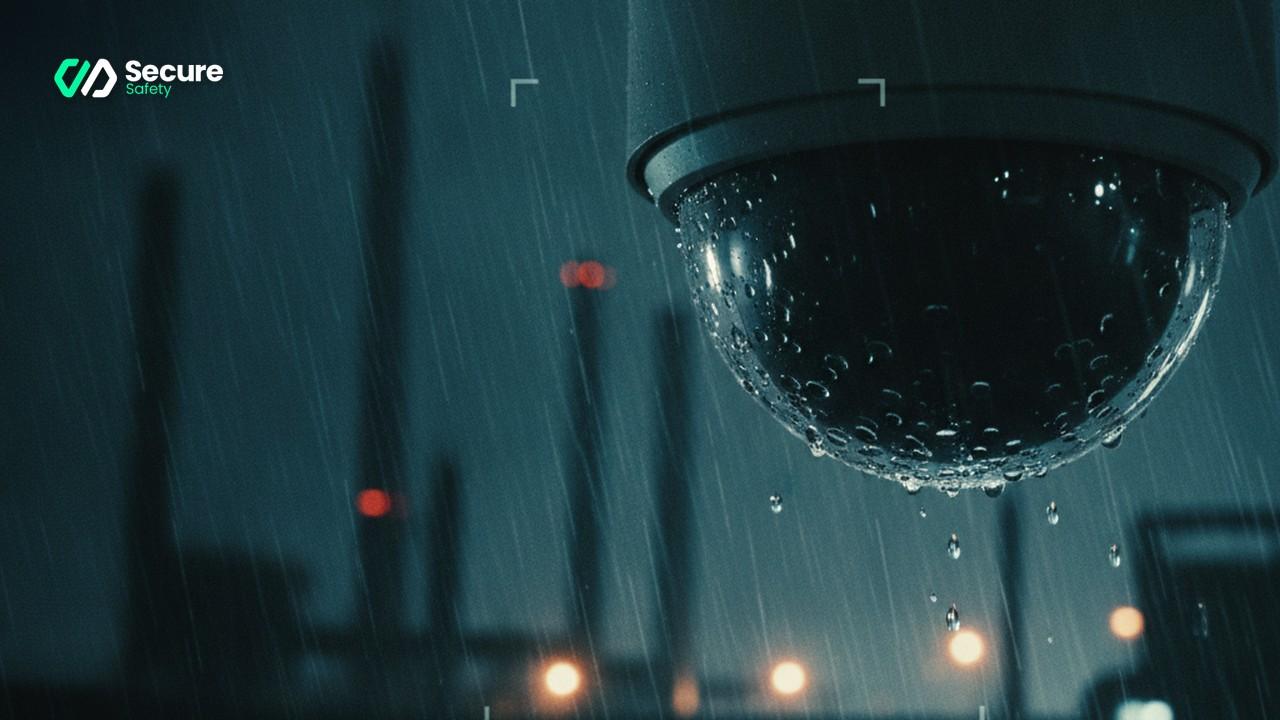
At 22:15 on a November evening, a petrochemical plant in the north of England has roughly four hours until sunrise. The sodium-vapour lights in the yard create deep pools of amber that fade quickly into shadow at the perimeter. Near the loading bay, two halogen floodlights have generated a strong backlight that turns the silhouettes of workers into flat dark shapes with no distinguishing features. One of the cameras near the gate has a thin water film across its dome casing — not quite enough to trigger a fault alarm, but enough to scatter the light from the adjacent security luminaire in a way that produces a persistent lens flare across the right quarter of the image.
A safety AI system that detects reliably in that image, on that camera, on that night, has been tested. One that only functions in the demonstration video taken on a clear August afternoon has not.
This is the test that separates reliable safety AI from products that look good in procurement presentations. It is also a test that most organisations do not run systematically — because it requires deliberate planning, happens in uncomfortable conditions, and needs to be scheduled well before the contract is signed.
The Four Lighting Failure Modes
Lighting is the first and most consequential environmental variable for computer-vision safety AI. Most detection models are trained primarily on daylight footage; the transition to low-light conditions reveals how robust the underlying model actually is. There are four distinct failure modes to test for.
Failure mode 1: IR night-vision mode switch. Most modern IP cameras switch to infrared night-vision mode when ambient light falls below a threshold — typically somewhere between 0.5 and 5 lux depending on the sensor and configuration. In IR mode, the camera removes its infrared-cut filter and captures near-infrared light rather than visible light. The result is a grey-scale image that looks superficially like a normal monochrome photograph, but has fundamentally different contrast characteristics: darker shadows, brighter reflective surfaces, and near-complete loss of colour information.
For a safety AI system that relies on colour to distinguish PPE — high-vis yellow, hard hat colours, coverall classifications — the IR mode switch is a serious problem. Yellow high-vis and a dirty white t-shirt may produce indistinguishable grey-scale signatures. A red hard hat and a blue hard hat are identical in tone under IR. If the detection model has not been specifically trained on IR footage and validated to handle colour-loss correctly, PPE detection degrades sharply after dark on any camera that switches to IR mode.
Failure mode 2: Glare and backlight. Security lighting — particularly the combination of sodium-vapour overheads and halogen task lights common in older industrial facilities — creates strong backlighting effects. When a camera faces toward a light source, or when a powerful light is in the frame periphery, the automatic exposure system compensates for the bright area and underexposes the subject, creating silhouette conditions where a worker becomes a dark shape against a bright background. Object detection algorithms that depend on feature visibility — the brim of a hard hat, the reflective strip on a vest — fail in silhouette conditions.
Failure mode 3: Deep shadow with mixed light sources. Industrial sites rarely have uniform lighting. A facility might have sodium-vapour overheads in the main yard, halogen work lights in active areas, and essentially no light in access corridors and between buildings. Where these zones are adjacent in a camera's field of view, the automatic exposure compromises between them — producing overexposure in bright areas and near-black in the shadows. A worker moving from light to dark within the same camera frame may simply disappear from the detection feed.
Failure mode 4: Mixed light source colour temperature. Sodium-vapour lights (warm amber, approximately 2,000K), LED security lights (cool white, 4,000–6,000K), halogen work lights (warm white, 3,200K), and the blue-white of winter dawn combining in a single camera frame create colour balance problems that confuse colour-dependent detection. High-vis yellow under sodium-vapour light appears orange. A white hard hat under sodium-vapour light appears cream or amber. A detection model not trained on mixed-temperature footage will classify these consistently incorrectly.
The Rain and Condensation Problem
Water causes two distinct problems for outdoor safety cameras: water on the exterior and water inside the housing.
Water on the dome or lens glass. Dome cameras — the type typically installed outdoors in industrial environments — have a transparent protective dome covering the lens. In rain, water runs down the dome surface and in some conditions forms a film across the forward-facing optical path. A heavy film diffuses the image and reduces effective resolution; a partial film creates localised blur and may scatter point-source light into streaks or halos that interfere with detection.
The practical effect depends on the camera's IP rating, the angle of installation (downward-facing domes shed water more effectively), and ambient temperature (cold domes accumulate condensation faster than warm ones). The key question for safety AI is not whether the camera handles rain at a hardware level — most IP66-rated cameras do — but whether the detection model has been validated against the image quality degradation that even an IP66 camera produces in sustained rain or overnight condensation.
Internal condensation. Sudden temperature drops — as experienced in a UK autumn or winter when a facility transitions from a warm daytime interior to a cold night — can cause condensation inside camera housings that have had their seals compromised through age, impact, or poor original installation. Internal condensation produces a diffuse haze effect across the entire image that is often mistaken for a camera fault rather than recognised as a detection-degrading condition. Regular inspection of camera housing seals, gaskets, and the integrity of any anti-condensation heater is a maintenance requirement for outdoor industrial cameras, not a one-time installation check.
BS EN 62676, the British Standard for video surveillance systems for use in security applications, specifies minimum requirements for camera installation in outdoor environments, including weather protection standards and power supply resilience. It is the relevant benchmark for camera installation quality in a UK industrial setting and provides the reference specification against which camera housing condition should be assessed.
What Happens to Colour-Coded PPE Detection in IR Mode
This deserves detailed attention because it is the failure mode most likely to remain invisible through a standard pilot.
A typical pilot runs for two to four weeks and builds confidence progressively, often starting with easier detection scenarios. If the pilot begins in summer or early autumn and the site operates primarily in daylight, the IR mode switch may simply not be encountered during the pilot period at all — and the organisation signs a full contract on the basis of a test that never covered its most challenging operating conditions.
In IR mode, the following specific failures occur with colour-dependent detection:
High-visibility yellow. Yellow high-vis is one of the most visually distinctive PPE items in daylight — almost nothing else on an industrial site is that colour. In IR mode, it becomes a mid-tone grey that may be indistinguishable from a dirty white t-shirt, a pale blue coverall, or a light-grey jacket. Detection accuracy for high-vis presence, not just absence, can drop significantly.
Hard hat colour coding. Many sites use hard hat colour to identify role, tier, or area access rights. In IR mode, a red, a blue, a yellow, and a white hard hat are all similar grey tones. Colour-coded enforcement is impossible without model training specifically on IR footage of the site's specific hard hat colour set.
Coverall classification. Chemical and process facilities use coverall colour to identify hazard level and zone permission. IR mode strips this classification capability entirely, reducing PPE detection to item-presence rather than item-type verification.
The solutions are not complicated, but they require deliberate action:
Request that the vendor demonstrate detection performance specifically on IR footage — not just daylight footage from a demonstration system. Ensure the pilot includes at least one two-week period covering the site's darkest operating hours on outdoor cameras. Where colour-coded PPE schemes are central to the safety case, either install white-light illuminators at key detection points to maintain colour visibility after dark, or confirm that the detection logic correctly identifies IR mode and applies a fallback rule that focuses on item presence rather than colour classification during hours when cameras operate in IR mode.
HSE's guidance document Lighting at Work (HSG38) notes that adequate lighting is a statutory requirement under both the Health and Safety at Work etc. Act 1974 and the Workplace (Health, Safety and Welfare) Regulations 1992. Lighting provision at camera detection points is simultaneously a statutory safety obligation and a detection quality requirement. The two align: sufficient lighting for safe work is also sufficient lighting for colour-mode camera operation.
Specifying Cameras for UK Outdoor Winter Conditions
Where the discovery phase identifies cameras inadequate for the detection required, replacement or supplementary specification should account for the following:
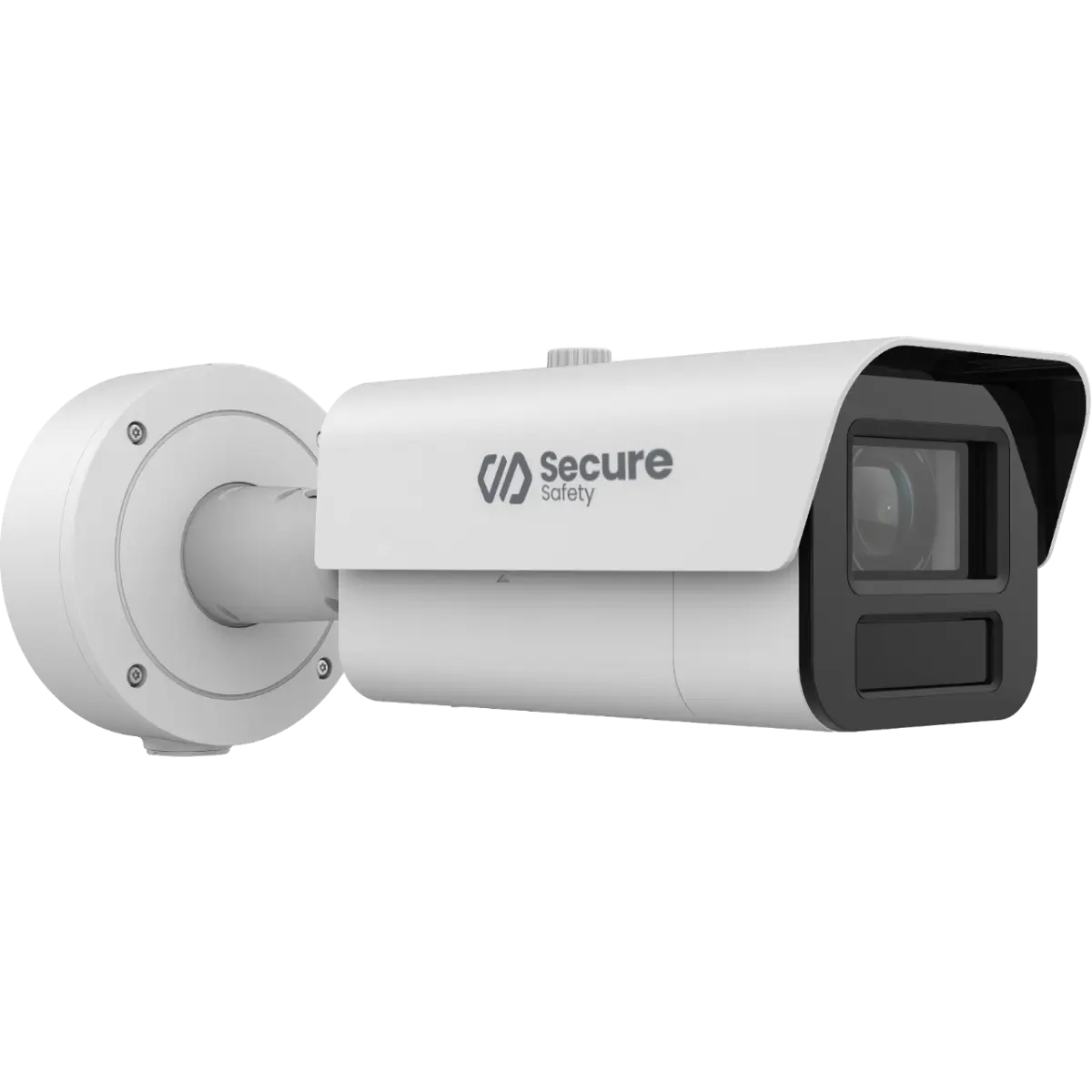 Camera specification matters as much as AI quality for night-shift performance. IP67-rated housings, heated domes and appropriate IR illumination ranges determine whether detection holds through a UK winter night shift.
Minimum illuminance for colour detection. A camera rated to produce colour video at 0.001 lux will maintain colour mode longer into a winter evening than one rated to 0.1 lux. For sites requiring colour-coded PPE detection throughout operational hours, the camera's minimum colour-mode illuminance specification is a purchasing criterion, not a cosmetic detail.
Camera specification matters as much as AI quality for night-shift performance. IP67-rated housings, heated domes and appropriate IR illumination ranges determine whether detection holds through a UK winter night shift.
Minimum illuminance for colour detection. A camera rated to produce colour video at 0.001 lux will maintain colour mode longer into a winter evening than one rated to 0.1 lux. For sites requiring colour-coded PPE detection throughout operational hours, the camera's minimum colour-mode illuminance specification is a purchasing criterion, not a cosmetic detail.
Sensor size and aperture. Large-format CMOS sensors with wide-aperture lenses capture significantly more light than standard sensors, and in practice a camera with a good low-light sensor may maintain colour detection to the same threshold as the site's security lighting — meaning it never switches to IR mode if the lighting provision is adequate.
IP rating and operating temperature. For UK outdoor industrial environments, IP66 is the minimum weather protection rating. In coastal or high-wind locations, IP67 or IP68 provides additional protection against driving rain and water ingress. The camera's operating temperature range should extend to at least −20°C for winter reliability, with an integrated heater for environments that regularly approach or fall below 0°C.
Anti-fogging and hydrophobic dome glass. Some manufacturers offer dome glass with hydrophobic (water-repelling) or anti-fog coatings that reduce the lens-film effect in rain and minimise the overnight condensation that is common in British winters. For cameras in exposed outdoor positions at high-value detection points, this is a practical specification addition.
Wiper mechanisms. For critical detection points — vehicle-pedestrian crossing zones, PPE gate entry points — a dome camera with an integrated wiper mechanism maintains image quality in sustained rain. These are more expensive and require additional maintenance, but for a limited number of high-priority positions the detection improvement justifies the cost.
The Night-Shift Acceptance Test Protocol
A structured night-shift acceptance test should be run before a safety AI deployment is signed off for live operation. The following protocol covers the core conditions:
Test conditions to validate:
| Condition | Cameras to test | Pass criteria |
|---|---|---|
| Full IR night mode | All outdoor cameras during operational hours | Item-level PPE presence detection maintains ≥90% accuracy versus daylight baseline |
| Partial rain on dome | Gate and entry-point cameras | Detection accuracy degrades by no more than 15% versus dry baseline |
| Backlight / silhouette | Cameras facing light sources | Person-in-frame detection maintains ≥85% accuracy |
| Mixed light sources | Cameras covering sodium-vapour and LED zones | Degradation in colour zones noted and documented; detection logic applies correct fallback |
| Deep shadow zones | Cameras covering poorly lit access routes | Detection maintained at camera areas above minimum illuminance; below-threshold zones flagged clearly |
| IR mode with colour-coded PPE | All cameras enforcing colour-specific rules | System applies correct fallback logic; no false-positive compliance readings in IR mode |
Night-shift test procedure:
- Run the acceptance test between 22:00 and 04:00 on two non-consecutive nights.
- Use test subjects with defined PPE states — fully compliant, missing specific items, wearing incorrect colour-coded items — and record the system's detections against the known ground truth.
- Repeat each scenario a minimum of ten times per camera to generate statistically meaningful accuracy figures.
- Document conditions at each test point: ambient light reading in lux using a calibrated light meter, precipitation type and rate, ambient temperature.
- Verify camera heater function at sub-5°C by confirming dome glass temperature differential.
- Test alert routing under night-shift staffing conditions — alerts should reach the on-shift supervisor using the night-shift rota, not the day-shift contact list.
UK-Specific Seasonal Risks
A UK industrial site operating year-round faces a seasonal risk profile that differs from continental European or equatorial deployments:
Day length. In December, sunset in northern England occurs before 15:30. A standard day shift running to 17:00 operates entirely in darkness for its final ninety minutes. An AI system that performed well in a summer pilot and was deployed in October may spend more than half its operating hours in conditions it was never validated against.
Cold-weather PPE layering. British workers in outdoor environments during winter add layers — fleece liners under coveralls, weatherproof high-vis jackets over base PPE, balaclava liners under hard hats. The visual profile of a compliant worker in January differs from the same worker in July. Detection models trained exclusively on summer data generate higher false-positive rates in winter when cold-weather kit changes the visual signature of PPE items.
Increased condensation risk. The transition between autumn and winter is the highest-risk period for camera housing condensation, particularly in facilities generating heat — food processing, chemical plants, engine rooms — where the differential between camera housing temperature and external ambient can be significant. Condensation typically manifests gradually, degrading detection quality without triggering a fault alarm until the effect is severe.
Autumn rain frequency. The UK averages more than 150 rain days per year in many industrial regions. A camera deployment that has not been tested under sustained rain is not a deployment that has been tested. This is not a marginal condition — it is the baseline for roughly forty percent of operating days in many UK locations.
Camera Maintenance Schedule for Industrial Outdoor Environments
| Task | Frequency | Responsible |
|---|---|---|
| Visual lens and dome inspection | Monthly | Site maintenance |
| Dome exterior cleaning | Monthly or after adverse weather | Site maintenance |
| Housing seal and gasket inspection | Quarterly | Camera supplier or site IT team |
| Heater function check | Quarterly — mandatory before winter | Camera supplier or site IT team |
| Camera firmware update | As released by manufacturer | IT team with change management sign-off |
| Night-shift detection performance spot-check | Quarterly | Safety AI vendor or trained site team |
| Full night-shift acceptance re-test | Annually and after any camera replacement | Safety AI vendor |
Offshore Proof in the Hardest Conditions
SecureSafety's detection capability was developed and validated in the harshest camera environments the oil and gas industry presents: sea spray on dome cameras, IR cameras operating on dark nights at 57° north, sodium-vapour deck lighting generating the same backlight and mixed-source problems that any UK industrial site faces in November. The drill-floor footage embedded above is operational footage from a live deployment — in the conditions that platform presents every winter night, not a controlled demonstration clip.
The result: a sub-0.05% error rate, maintained across approximately 18,000 events processed daily, in conditions that defeat most detection systems. If the model works in driving North Sea rain on a pitching platform, it works in the warehouse car park and the chemical plant loading bay in December.
If you want to run a structured night-shift acceptance test as part of your evaluation — with defined test scenarios, pass criteria, and independent verification of results — book a demo. We will plan and run it with you, in the conditions your site actually presents.