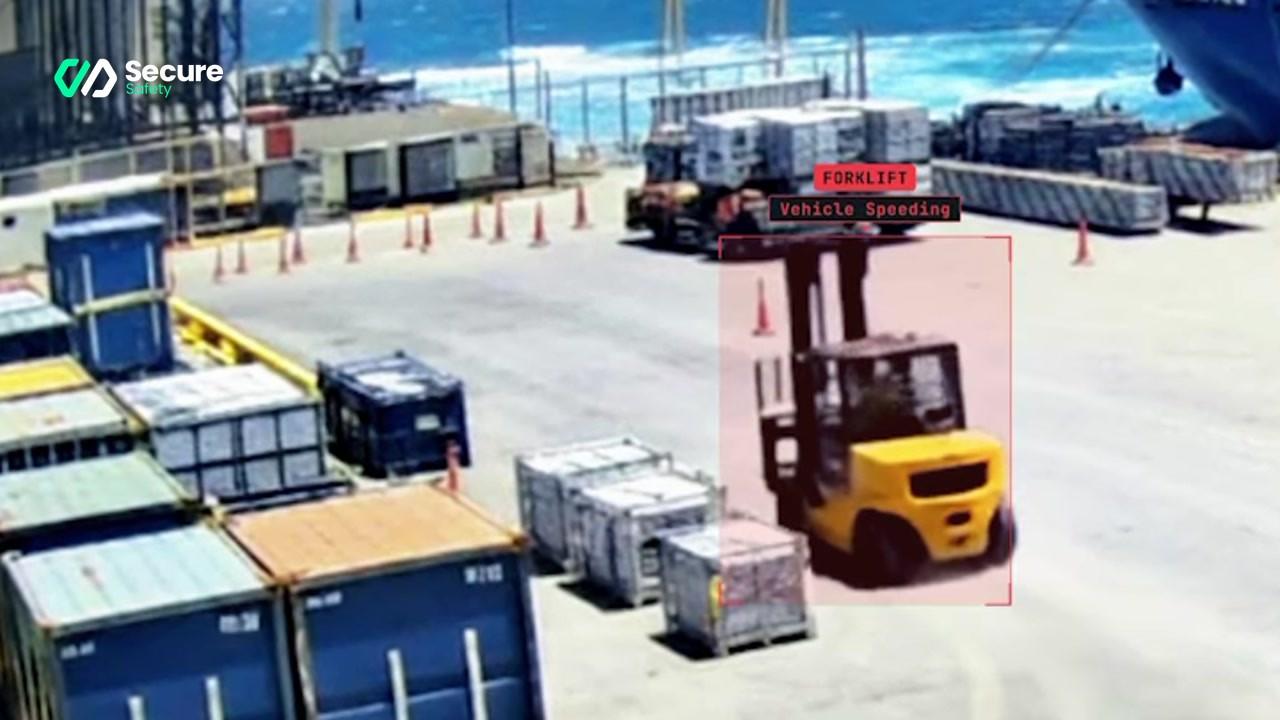
SecureSafety vehicle proximity detection — forklift and pedestrian conflict flagged before contact.
The driver did not see her. That is the sentence that appears more than any other in RIDDOR investigation reports involving loading bays — usually at dusk, usually during a reversing manoeuvre that had been made a thousand times before without incident. This particular time, the pedestrian was walking a route she had walked every shift for three years. The HGV was reversing in the way HGVs reverse. The bank of CCTV cameras above the loading dock recorded everything. Nobody was watching.
Every year during Road Safety Week — the national campaign run by Brake, held in the third week of November — public attention turns to road casualties: speed, drink-driving, mobile phone use, the deaths of cyclists and pedestrians on public carriageways. All of that matters enormously. But there is a parallel crisis that Road Safety Week rarely reaches, playing out inside site perimeters across the UK, in yards and loading bays and warehouse aisles, where the vehicle safety regulation is weaker, the engineering controls are thinner, and the fatality data, when you read it closely, tells a troubling story about what the industry has not yet fixed.
The HSE data behind the headline
The HSE publishes annual workplace fatality statistics every July. The 2025/26 figures — covering approximately 138 fatal workplace injuries across Great Britain — continue a pattern that has held throughout the last decade. Around 24 of those fatalities, broadly consistent with the figures in the HSE's published annual series, involved workers being struck by a moving vehicle. That is roughly one in every six workplace deaths: a category exceeded in frequency only by falls from height.
These are not road traffic accidents in the conventional sense. They are deaths in yards, distribution depots, construction sites, ports, food manufacturing facilities, and farms — environments regulated by the Workplace (Health, Safety and Welfare) Regulations 1992 and the Health and Safety at Work Act 1974, not the Highway Code. The vehicle involved is usually a forklift, an HGV, or heavy plant. The pedestrian is usually a colleague. The location is usually a place both parties use every day, without incident, until the one day they do not.
The HSE categorises these deaths under "struck by moving vehicle" — a clinical shorthand for collisions that were, in most cases, preventable by controls the employer either had not implemented or had allowed to fall into practical disuse. Road Safety Week, in its public road framing, implicitly treats these deaths as a different category. They are not. They are vehicle-meets-pedestrian fatalities. The prevention logic is the same. The implementation record is not.
Why workplace vehicle safety lags public road standards by a generation
Pull up a modern road vehicle and you will find: rear-view cameras, ultrasonic parking sensors, automatic emergency braking, blind-spot warning systems, and in goods vehicles over 3.5 tonnes, mandatory proximity warning systems required by progressive regulation. These are engineering controls embedded in the product, required by law, and enforced at point of manufacture.
Pull up a forklift truck operating inside a warehouse and you will typically find: the operator, a horn, a reversing alarm, and — if the site has invested — convex mirrors at aisle ends and painted pedestrian crossing zones on the floor. The gap between the engineering sophistication applied to vehicles on public roads and the same vehicles once they cross a site boundary is extraordinary, and it is almost entirely the product of different regulatory regimes applying radically different levels of pressure.
The HSE's 2021 workplace transport safety guidance sets out the principles clearly under the "safe site, safe vehicle, safe driver" framework. It requires employers to plan for the separation of vehicles and pedestrians, to establish designated pedestrian routes, to manage reversing operations carefully, and to assess all traffic routes as part of the site risk assessment. The guidance is sound. The problem is that it competes for attention alongside guidance on dozens of other workplace hazards, is not enforced with the same systematic momentum as product safety standards, and leaves implementation to site operators who are often managing lean safety teams against significant throughput pressure.
The scenarios that kill — and their common factors
Forensic analysis of workplace vehicle fatalities reveals three recurring collision scenarios with near-clockwork consistency across the published investigation record.
Reversing at loading bays. The pedestrian is in the swept path. The driver's rearward visibility is obstructed by the vehicle structure, a loaded trailer, or the geometry of the bay. The mirrors show only part of the scene. The reversing alarm sounds, as it always does, and nobody is listening because it sounds every time the vehicle reverses and has long since lost its informational value. The collision happens at low speed — slow enough to be survivable if the pedestrian is not pinned against a fixed structure. Often they are.
Forklifts at aisle ends. A pedestrian rounds the corner at the end of a racking aisle as a forklift exits at speed. The operator's forward sightline is blocked by the load. The pedestrian has no warning. Injury from these collisions is disproportionately severe because the point of contact is often the mast or the load, not a yielding front surface. The combination of forklift speed, load obstruction, and aisle-end geometry creates a proximity hazard that convex mirrors can partially address but cannot eliminate.
Pedestrians crossing informal vehicle routes. In sites where vehicle and pedestrian routes are poorly defined or where formal routes are informally abandoned for convenience, pedestrians develop shortcuts that cross vehicle transit lanes. These feel safe because they have always felt safe — until the shift pattern changes, or the vehicle is moving faster than usual, or the pedestrian does not check. The route has been walked a hundred times. The hundred-and-first is different.
The common factor across all three scenarios is not driver negligence or pedestrian error. It is a gap in the detection architecture: a moment in which a vehicle and a pedestrian are moving towards each other and nobody — not the driver, not the pedestrian, not the supervisor — has the information in time to act.
The hierarchy of controls for yard vehicle safety
Effective workplace vehicle safety follows the standard hierarchy, applied specifically to the vehicle-pedestrian interface:
Elimination — remove the need for vehicles and pedestrians to share operational space. Automated materials handling, segregated loading bays, drop zones outside the pedestrian perimeter. This is the ideal solution and is rarely achievable across an entire site.
Substitution and redesign — reconfigure traffic routes to eliminate crossing points, install physical barriers between vehicle aisles and pedestrian corridors, redesign loading bay access. The most effective long-term engineering investment.
Physical barriers and signage — speed control measures, segregation barriers, kerbs, warning signs, mirror systems at aisle ends and blind corners. Effective when respected; less effective when normalised through familiarity.
Detection and alert systems — systems that identify vehicle-pedestrian proximity in real time and trigger an alert before contact occurs. The layer at which technology intervenes in the chain of events.
PPE — high-visibility clothing, steel-capped footwear, head protection. The final layer. Effective at improving survivability. Not effective at preventing collisions.
AI proximity detection operates at level four. It does not replace physical segregation — it extends the detection layer to cover the gaps that physical controls cannot reach: the moment the barrier ends, the informal crossing, the loading bay during shift changeover when pedestrian exclusion is informally suspended, the aisle end that cannot accommodate a mirror.
What conventional yard CCTV misses — and why AI changes the architecture
Most logistics and distribution sites with loading bays have CCTV coverage of those bays. Most of that CCTV is monitored reactively — reviewed after an incident has occurred, used for investigation, occasionally observed in real time by a control room operator whose attention is divided across many tasks and many screens.
The coverage exists. The coverage is not working as a prevention tool.
The limitation is not the camera; it is the human attention on which the camera depends. A loading bay camera records thousands of events per shift. Almost all of them are safe. The unsafe ones — the proximity violation, the pedestrian in the reversing path — look identical to safe events from a distance until the last moment. Identifying them in real time requires sustained, undivided attention to each individual camera, which no realistic staffing model provides.
AI proximity detection changes the architecture at the point where human attention fails. The camera stream is analysed frame by frame, continuously, not by a person watching for danger but by a detection model trained to identify the specific spatial relationship between a moving vehicle and a person within a defined proximity threshold. When that threshold is crossed, the alert is triggered — to the control room screen, to the supervisor's radio, to the driver's in-cab display, to whatever response channel the site configuration specifies. The reversing alarm becomes targeted. The alert is evidence-based.
In SecureSafety deployments, this detection operates at sub-200ms latency: the gap between a proximity violation being registered and the alert leaving the system is shorter than a human reaction time. In a reversing scenario at walking pace, that difference can determine whether the alert enables intervention or merely documents what has already occurred.
10-point yard transport risk assessment checklist
Conduct this assessment annually, and repeat it before any significant change to site operations, traffic volumes, or workforce configuration:
| # | Assessment Item | Pass / Gap / Fail |
|---|---|---|
| 1 | All vehicle and pedestrian routes mapped and formally documented | |
| 2 | Physical segregation is continuous, with no uncontrolled crossing points | |
| 3 | All reversing manoeuvres inventoried; reversing restricted to designated zones where practicable | |
| 4 | Each vehicle type assessed for blind spots in the specific operational environment | |
| 5 | Pedestrian exclusion maintained through shift changes, including during loading operations | |
| 6 | Loading bay pedestrian access controlled by physical means, not procedure alone | |
| 7 | Site speed limits defined, signed, enforced, and included in driver induction | |
| 8 | Contractors and temporary workers inducted into site transport controls before entering vehicle areas | |
| 9 | Yard CCTV monitored in real time with defined responsibilities and coverage of all vehicle-pedestrian conflict zones | |
| 10 | Vehicle-pedestrian near-misses actively reported, logged, and used to identify hazard hotspots |
Any item answered "Gap" or "Fail" should be assigned a corrective action with a named owner and completion date before the next operating cycle.
Offshore proof: 13 rigs, sub-0.05% error, 80% reduction
The environments in which SecureSafety has operated since 2018 — thirteen offshore rigs, a national oil major's operations, a major South American port, and an international airport — represent extreme instances of the same fundamental challenge: high-density vehicle movement in constrained operational space, with pedestrians and vehicles sharing working areas under sustained time pressure, at all hours, in all weather.
In those environments, AI proximity detection has operated continuously across approximately 18,000 daily events, at a sub-0.05% error rate, delivering a measured reduction in unsafe vehicle-pedestrian behaviour of around 80% from the pre-deployment baseline.
That reduction does not come from replacing the safety team. It comes from giving the safety team information they previously did not have, in time to act on it. The loading bay that previously had visibility only when a supervisor happened to be present now has continuous detection. The aisle end that physically could not accommodate a mirror now has a detection event logged every time the proximity threshold is breached.
Road Safety Week draws attention to preventable tragedy on public roads. The parallel tragedy — inside the fence, in yards and loading bays, structurally under-reported — deserves the same engineering rigour applied to the same problem. The controls exist. The detection technology works. The question is whether organisations are prepared to apply it before the next RIDDOR investigation begins.
Book a demo to see what AI proximity detection would change in your yard.