
\"SecureSafety at a major port — one of multiple live deployments in a multi-site rollout.\"
The safety director of a national oil major had what looked like a straightforward programme. The AI safety deployment on their flagship North Sea installation had run for eighteen months, logged roughly 18,000 daily safety events, and produced measurable reductions in unsafe behaviour across every hazard category monitored. The board wanted the same results across the remaining eleven sites. The director signed off the expansion, distributed ownership to each site safety manager, and waited.
Twelve months later, every site was technically running safety AI. But the alert thresholds were different at every location. The reporting formats were incompatible. Two sites had drawn their pedestrian exclusion zones from scratch, without referencing the boundary logic refined over eighteen months offshore. One site had disabled PPE detection entirely following contractor pushback, with no escalation to the group team. And when the safety director sat down to review group-level performance, there was nothing meaningful to compare — because the sites were not measuring the same things.
This is the failure mode that most multi-site AI rollout programmes encounter. It is almost always the result of the same management error: treating a portfolio programme as a series of independent deployments.
Why site-by-site fresh starts fail
The instinct to grant each site full ownership of their AI deployment has a reasonable basis. Industrial sites are operationally different. The hazards on an offshore rig are not the hazards at a distribution warehouse. Local knowledge is genuinely valuable. Autonomy tends to drive engagement more effectively than central mandates.
None of this requires each site to start from scratch.
When deployments are managed independently, three structural failures consistently emerge.
No learning transfer. The pilot site accumulates hard-won knowledge: which confidence thresholds minimise false alerts for your type of workforce, which camera angles provide adequate resolution for PPE detection in low winter light, how to write zone boundary rules that do not trigger on authorised maintenance access. None of this is written down. When the next site starts, it relearns the same lessons at the same cost — and often reaches worse conclusions, because the edge cases that informed the pilot's calibration are not visible to the new site's configuration team.
No governance comparability. A vehicle-pedestrian proximity alert threshold set at five metres on one site and twelve metres on another is not simply different — it is uninterpretable. You cannot place those two sites side by side in a quarterly management review and draw any valid conclusion about relative performance. The numbers appear comparable but are measuring entirely different things with entirely different tolerances.
No portfolio benchmarking. The most powerful management output from a multi-site AI deployment is the ability to rank sites by performance, identify the outliers, and systematically transfer the practices of the best performers to the worst. That capability only exists when all sites are operating to the same governance standard. Without it, you have a portfolio of separate pilots, each generating its own data, and none of it usable for group-level analysis or continuous improvement.
ISO 45001:2018 is explicit on this point. Clause 4.1 requires organisations to determine their context — including the internal issues relevant to achieving intended OH&S outcomes. For a multi-site organisation, that context includes the relationship between sites and how the management system is designed to produce consistent performance across the portfolio, not just at individual locations. A fragmented deployment is a governance risk as much as an operational one.
The three-layer architecture
A workable multi-site programme separates what must be standardised from what can legitimately be localised. The framework has three layers.
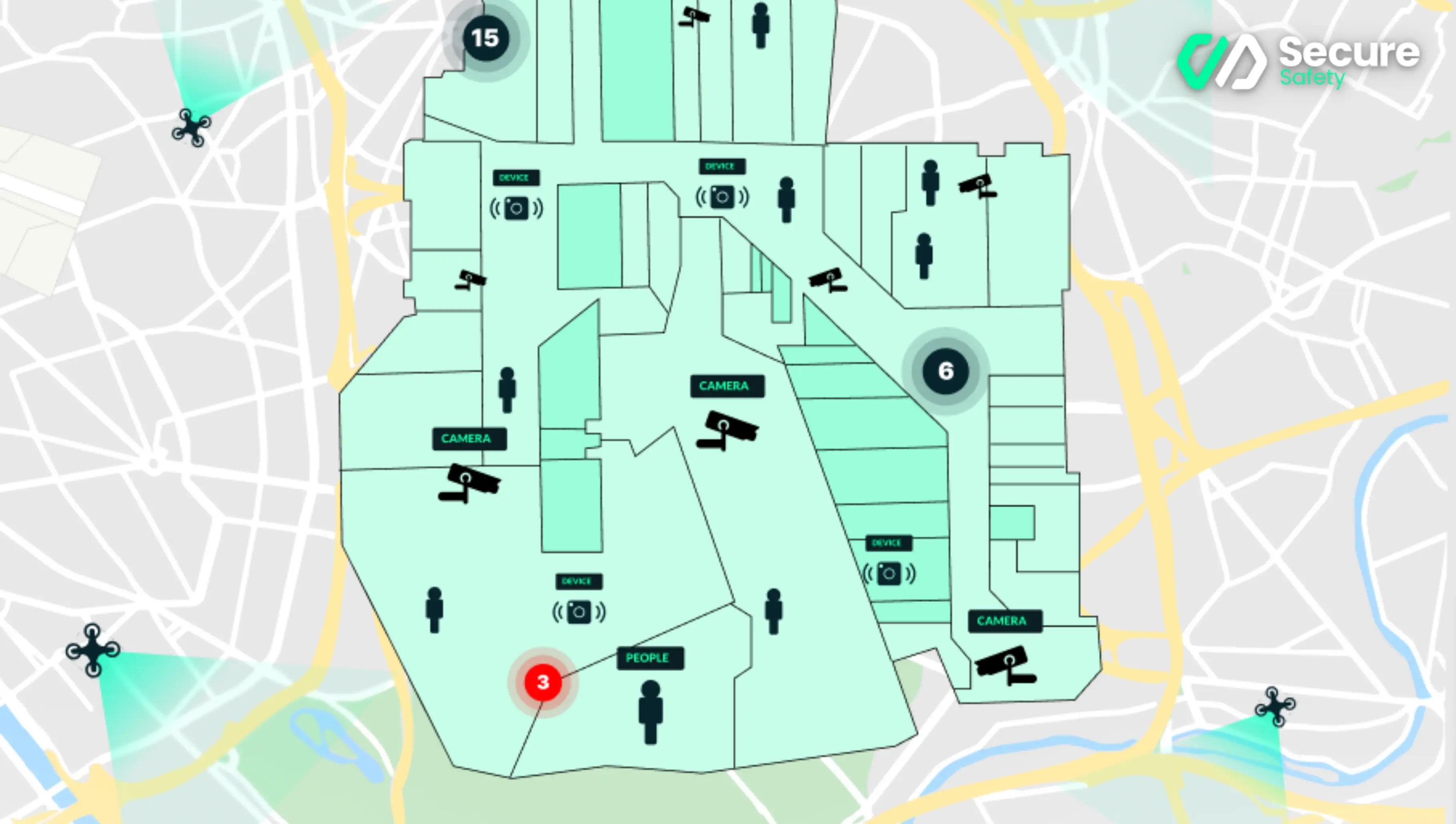 A shared site map with per-facility status indicators is the operational heartbeat of a multi-site rollout. Platform standards make it possible; per-site zone configuration makes it accurate.
Layer one: platform standards. These are non-negotiable across the estate. They define the minimum camera resolution specification, the edge compute hardware requirement, the software version in active deployment, the VMS integration method — ONVIF standard, API version, integration testing protocol — the network security and data retention policy, and the backup and failover configuration. Every site runs the same platform. Version divergence is the enemy of supportability, cross-site comparability, and cybersecurity assurance. A site running software that is two versions behind the estate cannot be managed, supported, or compared in the same breath as one running the current release.
A shared site map with per-facility status indicators is the operational heartbeat of a multi-site rollout. Platform standards make it possible; per-site zone configuration makes it accurate.
Layer one: platform standards. These are non-negotiable across the estate. They define the minimum camera resolution specification, the edge compute hardware requirement, the software version in active deployment, the VMS integration method — ONVIF standard, API version, integration testing protocol — the network security and data retention policy, and the backup and failover configuration. Every site runs the same platform. Version divergence is the enemy of supportability, cross-site comparability, and cybersecurity assurance. A site running software that is two versions behind the estate cannot be managed, supported, or compared in the same breath as one running the current release.
Layer two: governance standards. These define how the system is managed and reported, not what individual cameras are configured to detect. They include the naming convention for detection zones across all sites; the alert classification categories and their associated escalation procedures; the reporting cadence — daily event logs for site management, weekly summaries for site directors, monthly performance reports for the group safety function; the incident classification protocol when an AI alert precedes or correlates with a recorded injury or near-miss; and the format for the quarterly compliance audit each site is required to complete. Governance standards ensure that every site is accountable to the same management framework, regardless of the underlying hazard profile.
Layer three: site-specific configuration. This is where localisation is both appropriate and necessary. Zone maps reflect each site's physical layout. PPE rules reflect the specific requirements of each site's hazard register. Detection sensitivity is tuned to the risk profile of each zone. Shift schedules define which rules apply during operational periods and which during maintenance windows. Alert delivery is configured to the control room infrastructure, radio network, and smartwatch fleet at each site.
The discipline of the programme is in knowing clearly which layer a configuration decision belongs to — and not permitting site-level flexibility to override the first two layers without group-level approval and review.
Building a centre of excellence
Multi-site AI deployment requires a small expert function at group level that owns the platform and governance standards. This is not a policing operation; it is the institutional memory of the programme, and the mechanism by which learning compounds across the estate rather than remaining siloed at each site.
For a portfolio of ten to fifteen sites, this function typically requires two to three people: a programme lead with combined EHS and technology experience, a data analyst who owns cross-site reporting and benchmarking, and a technical lead who manages version deployment and VMS integrations. The function requires genuine authority to set and enforce Layer one and Layer two standards — the value of having it collapses immediately if sites can negotiate exceptions without documented justification and group review.
The centre of excellence performs four functions that no individual site can replicate. It captures and formalises the learning from each deployment, updating the platform and governance standards as evidence accumulates. It reviews all proposed configuration changes against the governance framework before they go live. It runs the quarterly benchmarking process and publishes the cross-site performance comparison. And it manages the relationship with the technology provider, ensuring that software updates are tested and deployed consistently across the estate rather than trickling in site by site.
Sequencing rollouts by risk profile
The first question in any portfolio programme is which site goes next. The tempting answer is whichever site is most technically ready: the newest cameras, the most cooperative site manager, the fewest integration complications. This reasoning optimises for deployment speed and minimises short-term difficulty. It is not the right answer.
The correct sequencing is by risk profile. The sites with the highest injury frequency rates, the most significant regulatory exposure, and the most complex hazard environments should be prioritised. There are two clear reasons for this. First, the harm reduction impact is greatest where risk is highest — that is where the safety case to the board is most compelling and most legible in outcomes. Second, high-risk, high-activity sites generate more events, more data, and more edge cases during deployment. The learning captured from a complex, high-hazard site is more transferable across the programme than the learning from a straightforward one.
A practical scoring method is to rate each site across three dimensions: the historical RIDDOR reportable incident rate per 100 workers — HSE publishes sector benchmarks that provide comparison context — the site's recent HSE enforcement history, and an estimate of deployment complexity based on camera inventory, VMS integration requirements, and number of detection types required. The highest-risk, lowest-complexity sites move first. High-risk, high-complexity sites are sequenced once the centre of excellence has deployment experience to draw on.
The site-readiness assessment
No rollout should commence without a structured readiness assessment. This is a half-day review conducted by the centre of excellence with the site safety manager and facilities team. It covers: camera inventory — count, positions, resolution, current VMS, access permissions; network infrastructure — bandwidth, firewall rules, IT department approval status; hazard register alignment — which detection types map to the site's actual significant hazards; control room capability — shift patterns, alert monitoring protocols, radio and smartwatch infrastructure; local PPE and zone requirements; and any pending enforcement action or legal proceedings that affect the deployment scope.
The assessment produces a configuration specification that feeds directly into the deployment. Sites that skip or compress the readiness assessment consistently encounter mid-deployment delays that cost more time than the assessment would have taken.
Once the system is live, the site safety manager is trained as the local administrator: qualified to adjust zone overlays, modify alert thresholds within documented tolerance bands, pull compliance reports, and manage the alert acknowledgement queue. This is a structured half-day practical session — not a product walkthrough. A supported period of two to four weeks follows, during which the centre of excellence reviews all configuration changes before they go live. Only after this supported period is ownership fully transferred to the site.
Cross-site benchmarking: the compounding return
The return on a multi-site deployment is not twelve separate safety improvements. It is the compounding effect that activates when sites are systematically compared against each other and best practices are formally transferred.
Once per quarter, the centre of excellence publishes a cross-site performance comparison using standardised metrics: the unsafe behaviour event rate per 1,000 working hours at each site, the alert acknowledgement rate, the false alert rate, and the trend over the preceding three quarters. Sites in the bottom quartile receive structured support from the centre of excellence. Sites in the top quartile are asked to document what they are doing differently, and that documentation feeds back into updated governance standards for the next programme cycle.
This mechanism works because AI-derived safety data is specific and granular in ways that injury statistics are not. A quarterly benchmarking cycle that identifies the installation with the lowest vehicle-pedestrian conflict rate and then interrogates that site's zone boundary placement, pedestrian gate design, and shift briefing format can surface transferable practices that no amount of peer review or safety walk would have revealed — because those practices are expressed in configuration choices and data patterns rather than in forms that a visiting safety professional would naturally observe.
HSE's guidance on health and safety management systems stresses that performance monitoring must provide data relevant to management review. Cross-site benchmarking is that mechanism at portfolio scale. It turns a distributed collection of deployments into a learning system — one where the performance of the weakest site can be lifted by the practices of the strongest, continuously and systematically.
The 20-point multi-site rollout checklist
Platform readiness
- Single software version confirmed across all active sites — no version divergence
- Hardware specification minimums confirmed at each site (camera resolution, edge compute specification)
- VMS integration method confirmed and integration-tested at each site before go-live
- Network bandwidth and firewall rules cleared with IT at each site
- Data retention policy agreed, configured, and documented at each site
Governance readiness 6. Zone naming convention documented and distributed to all site administrators 7. Alert classification categories and escalation procedures published in writing at group level 8. Reporting cadence and format agreed at site, site director, and group safety function level 9. AI-precursor incident classification protocol documented and communicated to site managers 10. Quarterly audit format agreed and assigned to the site safety manager as a standing responsibility
Site configuration 11. Site-readiness assessment completed; configuration specification signed off by centre of excellence 12. Camera inventory reviewed; any supplementary camera requirements identified and scheduled 13. Hazard register reviewed; detection scope confirmed against site's significant hazard list 14. Zone maps drawn and reviewed with the site safety manager and site operations lead 15. PPE rules and colour codes configured and tested against a representative sample of site workforce
Training and handover 16. Site safety manager local administrator training completed (half-day practical minimum) 17. Control room operator alert-response training completed — acknowledgement workflows and escalation paths 18. Supported configuration review period (minimum two weeks) completed before full handover 19. Escalation contacts confirmed at site, group safety, and technology partner level
Benchmarking 20. Site added to cross-site benchmarking dashboard; T+0 baseline metrics recorded for before/after comparison
Running this programme across thirteen offshore installations since 2018 — accumulating data on roughly 18,000 daily events across the estate — has produced something more valuable than safety improvement at any individual site. It has produced a tested governance framework and a benchmarked performance standard that tells every new site, from day one, what good looks like and what the gap is. That is what standardisation buys. The individual site numbers are the proof of concept. The programme — its governance, its learning transfer, its benchmarking — is the durable asset.
To discuss what a structured group-level rollout programme looks like for your estate, book a demo.