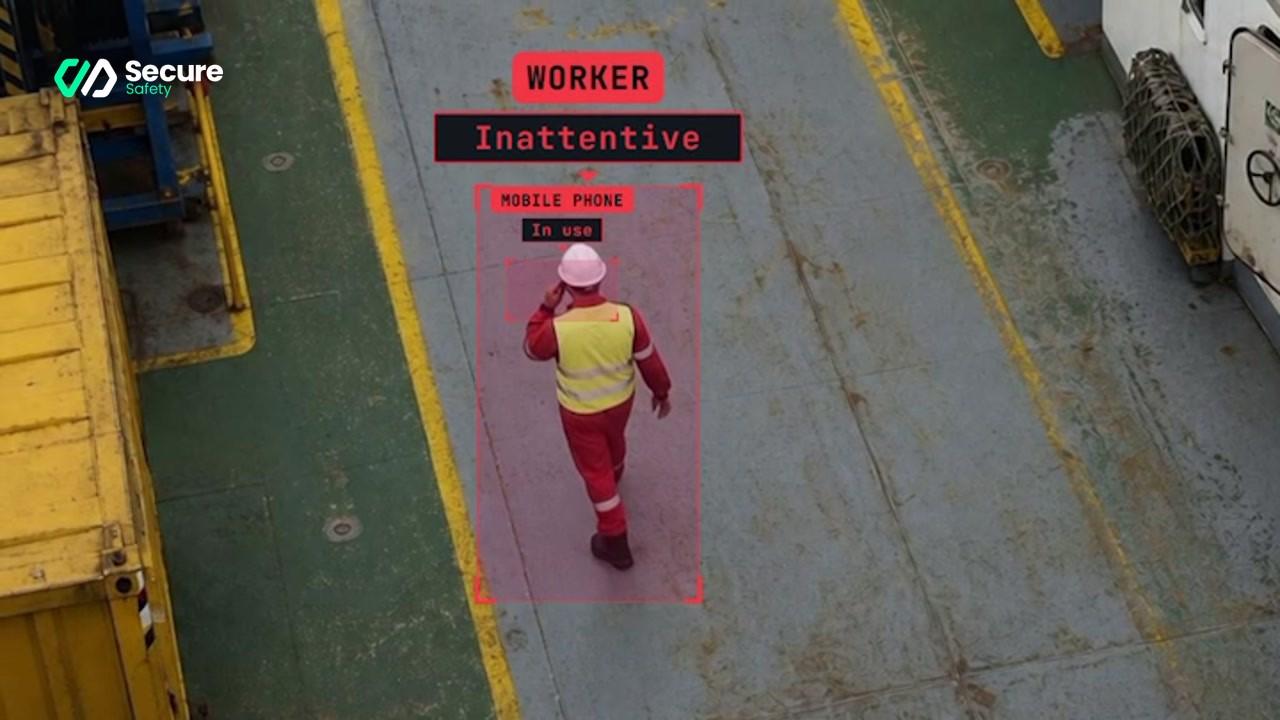
SecureSafety inattentiveness detection — observable behaviours only, no medical inference.
At 0340 on a night shift at a petrochemical processing facility, the instrument engineer at the secondary loop control panel had been on duty for six hours. His head dropped once, then recovered. Eleven minutes later, it dropped again. Over the preceding ninety minutes, the safety camera network had logged three head-drop events and two extended periods of fixed forward gaze. No alert reached anyone, because the deployment had been configured without a fatigue monitoring policy framework — the detection capability existed; the governance to act on it did not.
Six days later, a pressure relief event on the secondary loop was traced to a valve left in the test position during the 0400 handover. The incident investigation noted that the engineer had been working his sixth consecutive night shift. The near-miss was recorded. The fatigue monitoring data existed. The connection between them was never formally drawn, because no one had built the system to draw it.
Fatigue is one of the most consequential and least consistently managed hazards in high-hazard industrial operations. HSE estimates that fatigue is a factor in 20 per cent of serious road traffic collisions on the UK's roads, and EU-OSHA research identifies fatigue-related impairment as a significant contributing factor in process safety incidents, errors of omission, and delayed emergency response. In operations where the consequence of a single error is a major accident, fatigue monitoring is not a welfare nicety — it is a process safety control.
But the capability is also, simultaneously, one of the most legally and ethically complex areas in workplace safety AI. Understanding precisely what a camera can observe, what it cannot conclude, and what the UK's regulatory framework requires before a deployment is lawful is essential for any EHS professional considering it.
Why fatigue matters in high-hazard operations
The relationship between fatigue and error is well established in the industrial safety literature. Fatigue impairs cognitive function, reaction time, attention span, and decision-making quality in ways that the fatigued individual is often unable to accurately self-assess. The insight that people are poor judges of their own fatigue level — a finding supported by sleep research published in Sleep Medicine Reviews — has direct implications for self-reporting regimes that rely on workers to declare themselves unfit for duty.
In practice, high-hazard operations face a specific fatigue risk profile. Night shifts and extended shift patterns are common, particularly in offshore, continuous process, and critical infrastructure sectors. The operations most affected by fatigue — monitoring panels, maintaining vigilance during low-activity periods, executing multi-step procedures from memory — are precisely those that depend most heavily on sustained attention. And the consequences of a fatigue-related error are not confined to the individual: in a process plant, a confused valve state or a missed alarm during a tired handover can become a major incident hours later when conditions change.
HSE's guidance on fatigue at work identifies key risk factors: shift work, night work, extended working hours, insufficient recovery time between shifts, and long commutes. The guidance places responsibility on employers under the Health and Safety at Work etc. Act 1974, section 2, to ensure safe systems of work — a duty that cannot be discharged by roster management alone when the underlying impairment is not visible.
What cameras can observe
Camera-based fatigue and inattentiveness detection does not peer inside a worker's physiology. It observes behaviour. The distinction matters enormously, both technically and legally.
The behaviours that a trained computer vision model can reliably identify include: head position deviating below the normal upright working posture; head dropping and recovering — the characteristic micro-sleep head-drop pattern; direction of gaze relative to the expected work focus area; periods of prolonged absence of head movement; posture changes consistent with physical slumping; use of a mobile phone during a period when the worker should be attending to a task; and extended periods of eyes-closed or eyes-partially-closed posture.
These behaviours are observable because they are expressed physically and visibly in space, in the same way that a vehicle in a restricted zone or a worker without a hard hat is observable. The camera sees a head position. It sees a deviation from a baseline. It sees a pattern of events over time. These are factual observations about physical state, not conclusions about cognitive state.
A well-configured fatigue monitoring deployment will identify a pattern of inattentive behaviour events — not a single head drop, which might be a sneeze, but a clustering of events over a defined period that statistically exceeds the normal baseline for that location and that time of day. This pattern becomes the trigger for a human supervisor to make contact.
What cameras cannot diagnose
Here the boundary matters as much as what sits inside it.
A camera-based system cannot determine whether a worker is actually fatigued. It cannot assess cognitive impairment. It cannot evaluate reaction time, working memory, or decision-making quality. It cannot distinguish between fatigue caused by insufficient sleep, fatigue caused by a medical condition, fatigue caused by medication, grief, chronic pain, or any other physiological or psychological cause.
It cannot determine whether a worker is fit for work. It cannot produce a medical conclusion. It cannot diagnose a health condition, a mental health state, or a sleep disorder. And it absolutely cannot produce an output that says "this person is fatigued" as a clinical or quasi-clinical finding — because that would be inferring a health state from visual data, which takes the processing immediately into special category territory under data protection law.
This is not a limitation that better technology will overcome. It is a structural boundary between what observation can establish and what diagnosis requires. The camera observes behaviour. A supervisor — informed by the observed behaviour pattern, and by knowledge of the worker's shift history, role, and relevant context — makes a welfare judgement. The system is an input to that judgement, not the judgement itself.
UK GDPR, Article 9, and the inference problem
This distinction between observed behaviour and inferred health state is not merely a matter of technical accuracy. It is a legal threshold with significant compliance implications.
UK GDPR Article 9 prohibits the processing of special category personal data without a lawful basis. Special category data includes data concerning health. The critical question for any fatigue monitoring deployment is: at what point does the processing of visual data about a worker's behaviour constitute the processing of data concerning health?
The Information Commissioner's Office has addressed this in its guidance on biometric data and health data. Where a system uses physical or behavioural data to make inferences about a person's health state — including inferences about fatigue, illness, or physiological condition — the resulting data is treated as health data under Article 9, regardless of whether the underlying inputs were visual rather than medical. The inference, not just the data type, triggers the special category classification.
A system that logs head-drop events as observable behavioural data, without drawing any conclusion about whether the worker is fatigued or medically impaired, is processing behavioural data. A system that produces a "fatigue risk score" or outputs a conclusion that a worker is fatigued is processing health data, regardless of how the conclusion was reached.
This is the line that a lawful fatigue monitoring deployment must not cross. The system observes and reports patterns of inattentive behaviour. The inference about what those patterns mean for the worker's health or fitness for work belongs to a qualified human.
What a lawful fatigue monitoring framework looks like
Deploying camera-based inattentiveness detection within a lawful framework requires the following elements.
Observable behaviours only. The system is configured to detect and log specific, observable physical behaviours: head position, gaze direction, posture, phone use. It does not produce health inferences, fatigue scores, or fitness-for-work assessments. The output is a pattern of behavioural events and a supervisor alert.
Explicit disclosure to workers. Workers must be informed, before monitoring commences, that the system monitors for inattentive behaviour patterns and that a supervisor will be alerted if a pattern threshold is met. This disclosure must be clear, specific, and provided before the monitoring begins — not buried in a general CCTV notice. The ICO's guidance on transparency requires that workers understand what is being monitored and why.
Documented lawful basis. The employer must identify and document the lawful basis for processing under UK GDPR Article 6. For safety monitoring in a high-hazard environment, legitimate interests is the most commonly applicable basis, but it requires a documented legitimate interests assessment that weighs the safety purpose against the privacy intrusion. In some sectors, legal obligation may also be applicable.
Human review before any individual contact. The behavioural pattern alert reaches a supervisor. The supervisor — not the system — decides whether to make contact with the worker, what form that contact takes, and whether a welfare conversation, a rest break, or a fitness-for-work referral is appropriate. No automated response goes to or concerns the individual worker directly.
No automated disciplinary consequences. The data from a fatigue monitoring system cannot be used as the basis for disciplinary action without a human investigation and decision-making process that satisfies the requirements of the ACAS Code of Practice on disciplinary procedures.
Data minimisation and retention limits. Behavioural event data must be retained only as long as necessary for the safety purpose for which it was collected. Aggregate pattern data for operational analysis should be retained separately from event data that could identify an individual.
A policy framework for fatigue detection deployment
Before a fatigue or inattentiveness monitoring capability goes live, the following policy framework should be in place.
Scope definition: specify the locations to be monitored, the shifts and times during which monitoring operates, and the behaviours the system is configured to detect. Monitoring should be proportionate to the risk — a lone night-shift operator in a process control room presents a different risk profile from a worker in a busy daytime warehouse.
Threshold configuration: define the alert threshold — the pattern of events over a defined time window that triggers a supervisor notification. A single head-drop event should not be an alert trigger. A pattern of three or more events within forty-five minutes, or a sustained posture deviation lasting more than thirty seconds, is a more proportionate threshold.
Supervisor response protocol: document what a supervisor does when an alert fires. The protocol should specify: the obligation to review the footage before acting, the manner of contact with the worker, the escalation route if the supervisor has welfare concerns, and the documentation requirements. The protocol should be clear that the alert is a prompt for a welfare check, not an accusation of misconduct.
Worker communication: prepare a written disclosure notice that explains the monitoring capability, what it detects, how it is used, and how workers can raise concerns. This notice should be part of the site induction and should be revisited when monitoring is activated in a new location.
Exclusion from disciplinary use: include an explicit statement in the policy that fatigue monitoring data will not be used as direct evidence in disciplinary proceedings. It may, as part of a broader investigation, provide context — but the alert alone is not evidence of misconduct.
On offshore installations where SecureSafety has deployed inattentiveness monitoring, the consistently reported benefit is not the catching of individual lapses. It is the change in management awareness that the data makes possible: the site manager who can see, for the first time, that the highest concentration of inattentive behaviour events occurs in the last two hours of the night shift in the third week of a rotation, and who can use that pattern to inform roster design, fatigue risk assessments, and shift-end briefing protocols. The camera does not diagnose fatigue. It makes the invisible visible — and leaves the judgement where it belongs.
To discuss how inattentiveness detection is configured and governed on high-hazard sites, book a demo.