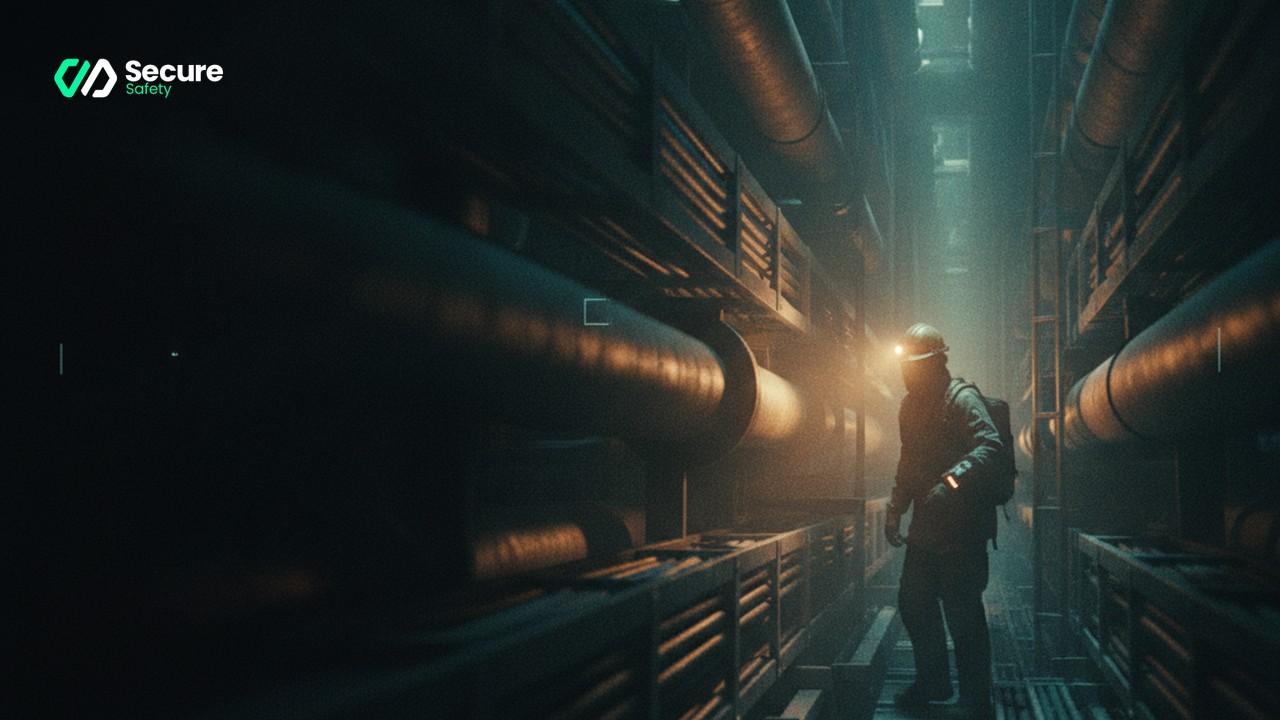
\"SecureSafety man-rider detection — coverage in the tight spaces where cameras alone cannot reach.\"
The lone worker check was due at 14:00. The supervisor acknowledged it at 14:07 without leaving the office — a phone call, confirmed safe, logged. What neither of them knew was that the worker had entered a confined tank space at 13:45 and had no means of raising an alarm once inside. The camera covering the tank entry had been repositioned during last month's shutdown and never returned to its original angle. The gap was eight metres of corrugated steel wall and nobody had noticed.
Camera-based AI safety monitoring is powerful precisely because it is continuous, objective and tireless. But it has a hard physical constraint: it only sees what the cameras can see. Every site has locations where cameras cannot go, angles that CCTV cannot cover, and scenarios where a worker is entirely outside the field of view of any detector. Treating camera-based AI as a complete solution — rather than one layer of a layered approach — is the most common strategic error in safety AI deployments.
This article maps the blind-spot problem systematically, then explains how to choose between three complementary technologies: camera extension, proximity beacons and wearable devices.
Mapping Blind Spots Before Choosing Technology
The first and most important step is not selecting technology — it is knowing where the gaps actually are. Too many sites skip this step and end up with a patchwork of sensors that covers the areas that were easiest to instrument, not the areas of highest risk.
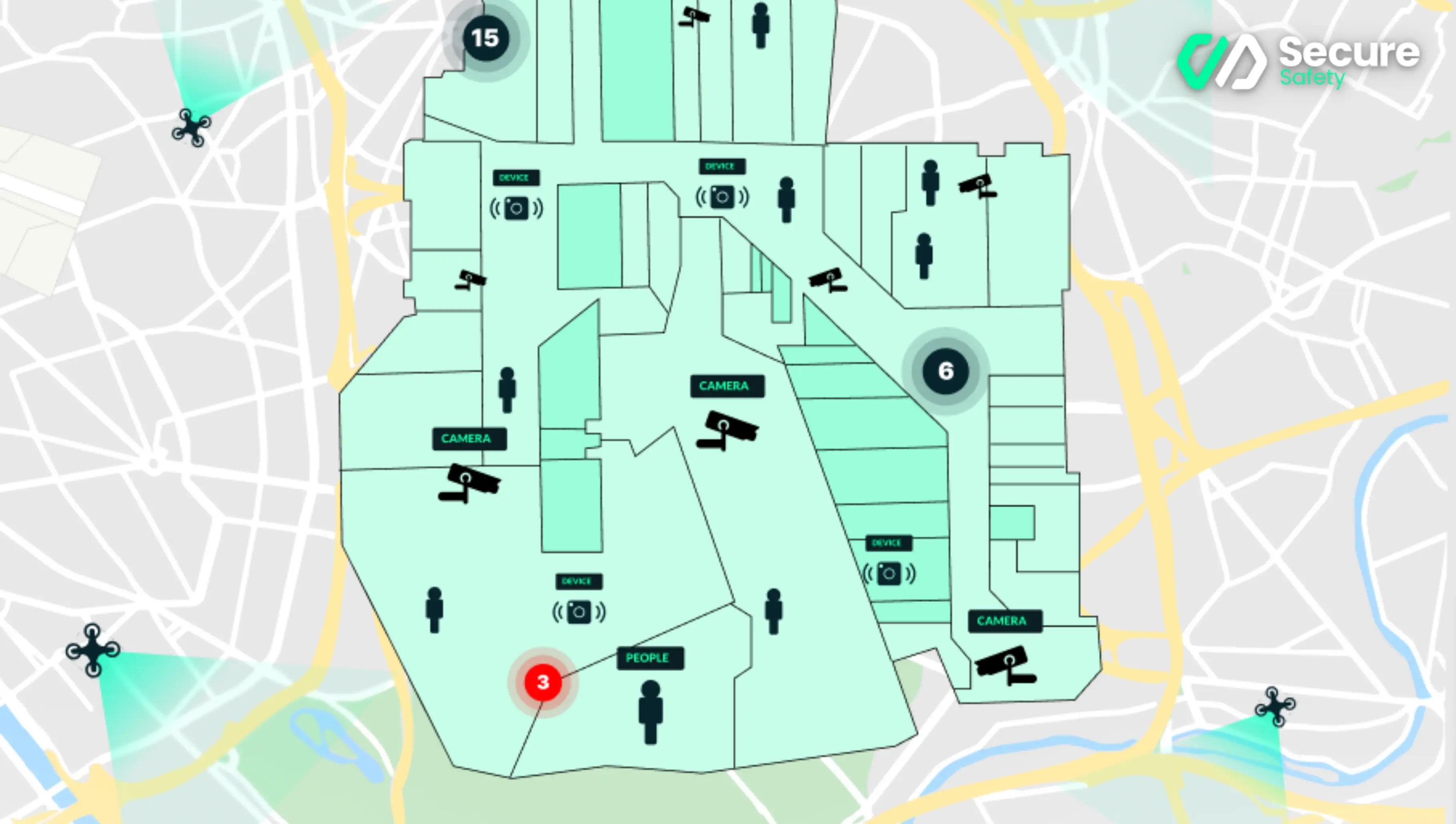 The SecureSafety site map makes blind spots visible before technology is selected — grey areas without camera icons are the zones the survey needs to resolve with beacons, wearables, or camera extension.
A structured blind-spot survey asks three questions for each area of the site:
The SecureSafety site map makes blind spots visible before technology is selected — grey areas without camera icons are the zones the survey needs to resolve with beacons, wearables, or camera extension.
A structured blind-spot survey asks three questions for each area of the site:
Is there a camera with a sightline to this location? Walk every area with a site plan and mark which zones have camera coverage and which do not. Include coverage quality — a camera angled at 60 degrees to a narrow corridor covers it differently than one pointed directly down the centre.
What hazards exist at this location? A blind spot in a low-risk cleanroom is a different problem from a blind spot at the base of a vertical ladder in an unventilated tank. Blind-spot significance is hazard-weighted, not just area-weighted.
How often are workers present here, and in what circumstances? A camera-dark area visited by ten workers per day requires different treatment from one entered once a week for scheduled maintenance.
The output of this survey is a prioritised blind-spot register: locations ranked by the combination of hazard severity and worker exposure frequency. That register, not vendor product sheets, should drive your technology choices.
Camera Extension: The Default First Answer
Before reaching for beacons or wearables, ask whether adding or repositioning cameras closes the gap. The economics of camera extension are often better than they appear: if existing VMS infrastructure already covers the area's network zone, adding a camera is primarily a hardware cost, and a safety AI platform that already runs on your existing cameras can extend to a new one without additional software licensing in most configurations.
Camera extension is the right answer when:
- The gap is in an area that workers pass through regularly, not just occasionally
- The gap involves dynamic hazards (vehicle movement, machinery in operation) rather than static presence risks
- The physical environment permits camera mounting and cabling
- The illumination is adequate for detection (or can be improved with supplementary lighting)
Camera extension is the wrong answer when:
- The location is a confined space where camera placement is physically impossible or would require impractical explosion-proof enclosures
- Workers are in the area infrequently and briefly — the cost-per-event of camera extension is too high
- The hazard is a lone-worker welfare check rather than a dynamic safety event
- Privacy concerns are heightened — some areas where cameras are legally or contractually inappropriate still require safety coverage
What Beacons Do — and What They Do Not Do
Proximity beacons are small battery-powered devices — worn on a lanyard, clipped to a hard hat, or integrated into a wrist band — that communicate wirelessly with fixed readers installed around the site. Their core capabilities are:
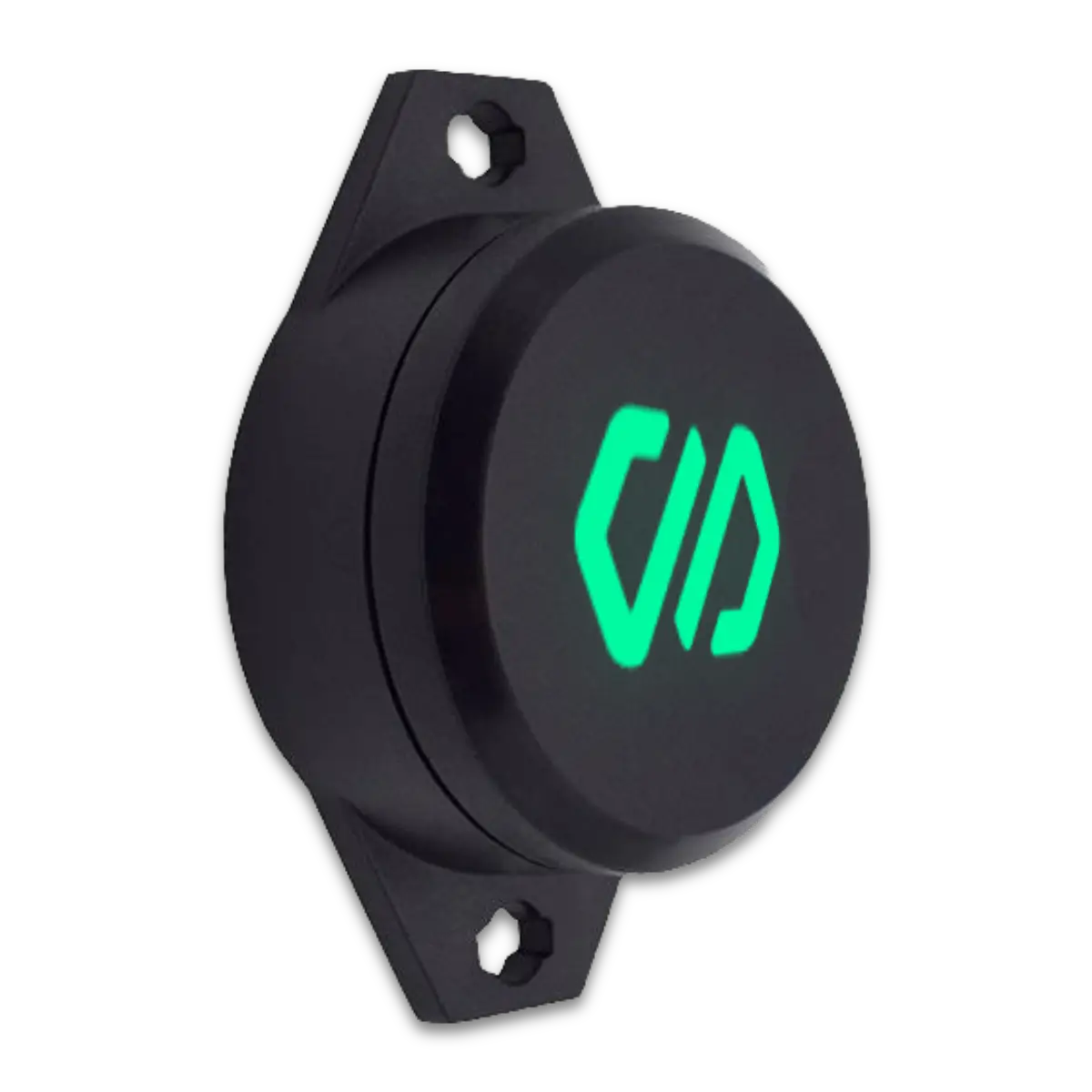 SecureSafety BLE beacons provide zone-level location awareness and man-down detection in areas where cameras cannot go — from cold stores to confined spaces to unmanned remote gantries.
Location awareness. Reader infrastructure can determine which zone a beacon-holder is in, to varying degrees of precision depending on the technology (BLE, UWB, RFID). This enables real-time occupancy of high-risk zones, automatic muster point counting during evacuation, and lone-worker check-in confirmation without a manual phone call.
SecureSafety BLE beacons provide zone-level location awareness and man-down detection in areas where cameras cannot go — from cold stores to confined spaces to unmanned remote gantries.
Location awareness. Reader infrastructure can determine which zone a beacon-holder is in, to varying degrees of precision depending on the technology (BLE, UWB, RFID). This enables real-time occupancy of high-risk zones, automatic muster point counting during evacuation, and lone-worker check-in confirmation without a manual phone call.
Man-down detection. Accelerometer-equipped beacons can detect when a worker has been stationary on the ground for longer than a configurable period and generate an automatic welfare alert. This is the core lone-worker application: no camera required, no manual check-in, just an automatic trigger if the device detects the absence of normal movement.
Zone entry and exit recording. In permit-to-work environments, beacon readers at zone boundaries can create an automatic record of who entered a controlled area and when — a significant audit-trail improvement over paper-based PTW systems.
What beacons cannot do is equally important to understand. Beacons do not see. They cannot detect PPE compliance, identify hazardous behaviours, recognise vehicle proximity or assess the specific nature of the risk a worker faces. A beacon says "this person is in this zone and has been stationary for three minutes." It does not say "this person has fallen and appears injured" or "this person has entered the zone without their harness."
Beacons are best understood as a location and welfare layer, not a detection layer.
Wearables: A Broader Sensor Platform
The term "wearable" covers a wider range than beacons. At the high end, wearable platforms integrate:
- Multi-gas detection (oxygen, H₂S, CO, combustibles)
- Environmental monitoring (temperature, humidity, noise level)
- Physiological sensing (heart rate, skin temperature — with the ICO caveats that apply to health data processing)
- Man-down and no-motion detection
- Two-way communication
- GPS/indoor positioning
For industries with specific toxic-atmosphere risks — oil and gas, chemicals, confined spaces, utilities — wearable gas detection is already a regulatory requirement in many scenarios. Integrating this with a safety monitoring platform, so that a gas alarm and a camera zone entry event appear in the same alert queue and timeline, creates a materially more useful picture than two disconnected systems.
For sites where physiological monitoring is considered, the data-protection constraints are significant. Heart rate and skin-temperature data constitute special-category health data under UK GDPR Article 9, requiring explicit processing justification, a DPIA, and strict access controls. Wearables that infer fatigue or stress from physiological signals face the same regulatory scrutiny as camera-based fatigue inference. The HSE has published clear guidance that fitness-for-work assessments must not be made by automated systems without human review.
A Decision Matrix: Which Technology Fits Which Scenario
| Scenario | Camera Extension | Beacon | Wearable |
|---|---|---|---|
| Worker in camera-dark corridor | First choice | Backup | Optional |
| Confined space entry | Rarely practical | Yes – zone entry + man-down | Yes – gas + man-down |
| Lone worker in remote outdoor area | Not practical | GPS beacon | GPS + environmental |
| Muster and evacuation headcount | Effective if cameras cover muster point | Yes – primary for indoor | Optional |
| Vehicle-pedestrian zone (camera dark) | Camera extension first | Proximity alert to vehicle driver | Not typical use |
| Maintenance in camera-restricted area | ATEX camera if feasible | Zone entry + man-down | Gas + man-down |
| Fatigue monitoring | Camera (with DPIA) | Not applicable | Physiological (with strict DPIA) |
| PPE compliance in dark corner | Camera extension preferred | Not applicable | Not applicable |
Integrating Layers Into a Single Safety Picture
The real value of combining cameras, beacons and wearables is not that each covers a different area — it is that they can be integrated to produce a more complete picture than any one delivers alone.
A worker entering a camera-monitored restricted zone while their beacon has been in a nearby camera-dark area for forty minutes and their wearable has detected three abnormal movement patterns produces a combined alert that is far more actionable than any of those signals alone. That integration requires a platform that accepts inputs from multiple sensor types and correlates them on a shared timeline — and it requires that the integration architecture was designed before devices were purchased, not after.
The integration questions to answer before choosing devices:
- What format does each device use for alerting — API, webhook, MQTT, proprietary?
- Can beacon location data be overlaid on the same site map as camera alerts?
- Can wearable alarms appear in the same control room queue as AI camera detections?
- Is the data retention and access control consistent across all sensor types?
- Does the combined data set require an updated DPIA?
Building the Coverage Map
Once the blind-spot register, technology choices and integration architecture are established, the result is a site coverage map that shows — for every area of the site — which sensor type covers it, what the detection capability is, and what the response workflow is.
That map should be a live document. Camera repositioning, site layout changes, new areas of operation and changing worker patterns all create new gaps. Reviewing the coverage map quarterly, and after every significant site change, is the operational habit that maintains the coverage standard you built at deployment.
SecureSafety's Discovery process includes a structured camera and coverage survey as a standard deliverable — identifying where camera-only coverage is sufficient and where beacon or wearable integration would meaningfully improve the safety picture. The goal is not to sell more sensors; it is to know which ones are actually necessary. Book a demo and we will show you what a combined coverage map looks like for a site similar to yours.
Blind-Spot Coverage Checklist
- Complete the blind-spot survey for every area of the site, mapping against hazard severity and worker exposure frequency
- For each high-priority blind spot, evaluate camera extension before reaching for beacons or wearables
- Select beacons for location, zone access, muster and man-down applications — not for detection
- Select wearables for toxic-atmosphere, environmental or high-risk lone-worker scenarios
- Document the processing justification and DPIA implications for any physiological wearable data before deployment
- Design the integration architecture (data formats, alert routing, site map overlay) before purchasing devices
- Create a combined site coverage map showing sensor type, detection capability and response workflow per area
- Review the coverage map quarterly and after any significant site change