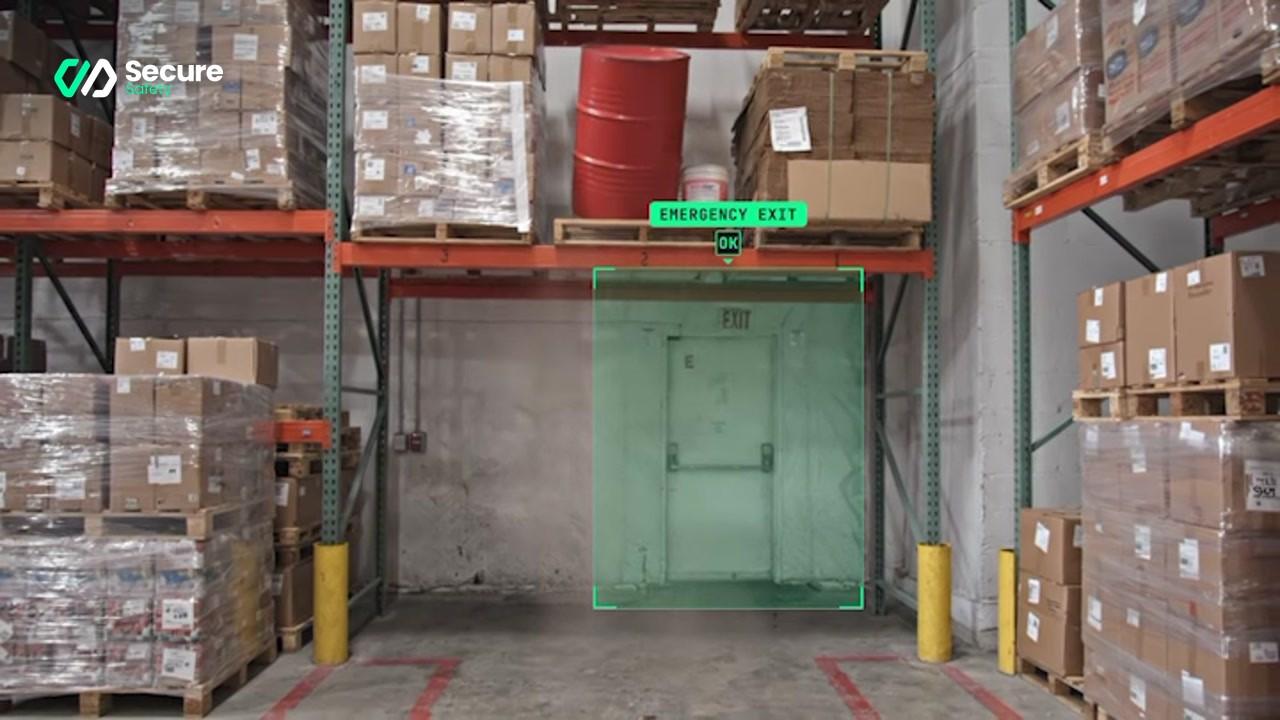
SecureSafety exit-route monitoring — blocked escape routes flagged in real time, not on the next walk-round.
An enforcement officer visited a logistics facility in the East Midlands following a routine inspection programme. The fire risk assessment, completed three months earlier by a qualified fire safety consultant, showed all nineteen emergency routes as unobstructed. The assessment had been conducted professionally: each exit had been walked, the clear zones had been checked, and the document signed off correctly. The enforcement notice, issued the following afternoon, cited seven obstructed emergency routes and three fire doors wedged open with pallets.
The enforcement officer's notes recorded that all ten violations appeared temporary in character. Three pallets staged pending allocation to racking. A portable air compressor parked against an emergency door because someone needed it near a maintenance job. Stretch-wrapped returns stacked under an emergency exit sign while waiting for a returns manifest. A fire door propped open with a broken-handled mop during a warm afternoon.
None of these obstructions had existed when the fire risk assessment was conducted. None of them required a deliberate decision to obstruct an exit — they were the ordinary, thoughtless by-products of a busy operational day. And none of them would have been visible to any inspector who had visited at 9am that morning.
The enforcement notice resulted in a formal improvement notice, a required remedial programme, and significant management time spent preparing a response to the enforcement authority. The underlying cause — the gap between the audit schedule and the operational reality of the site — remained entirely unaddressed.
How fire exit obstructions accumulate
Temporary obstructions do not appear as a single event. They accumulate in layers, incrementally, through decisions that each seemed entirely reasonable at the moment they were made.
A forklift driver needs to unload a delivery and the usual staging area is occupied. The nearest available floor space is beside the emergency corridor. The pallet goes down temporarily — it will be moved in five minutes. Two hours later, a second pallet is placed beside it. By the end of the shift, there is a stack of four.
A team carrying out maintenance work on a mezzanine platform needs to pass tools and materials through a fire door repeatedly over the course of the afternoon. Propping the door open is more practical than opening and closing it every ten minutes. Someone wedges it with a fire extinguisher base bracket. The job overruns. The night shift finds the door still propped.
A busy afternoon generates returns and damaged stock that needs to be segregated pending inspection. The inspection team is not available until tomorrow. The stock goes against the nearest wall — which is where the emergency stairwell access route is.
Each individual action is explicable. The cumulative result is a pattern of obstructions that develops through the working day and is invisible between walk-rounds. This is not a management failure of intention — it is a management failure of visibility.
The regulatory context
The Regulatory Reform (Fire Safety) Order 2005 — the primary fire safety legislation covering most non-domestic premises in England and Wales — places a clear legal obligation on the responsible person to ensure that escape routes and emergency exits remain available for use. Article 14 of the Order requires that escape routes are kept clear of obstruction and that emergency doors, in particular, can be opened immediately and easily from the inside when the building is occupied.
The duty is absolute and continuous. It does not contain a provision that reads "unless the obstruction is temporary" or "unless it was placed there for operational reasons." An obstructed escape route during a fire is a blocked escape route, regardless of the intention behind the obstruction or its duration.
The penalties for non-compliance are substantial. Under the Fire Safety (England) Regulations 2022 and the Fire and Rescue Services Act 2004, a responsible person can receive an enforcement notice requiring specific remedial action, a prohibition notice preventing use of the premises until remediation is complete, prosecution under the Fire Safety Order with unlimited fines on conviction, and, in cases where a fatality or serious injury results from a fire safety failure, personal liability for managers and directors under health and safety law.
Fire and Rescue Authorities publish anonymised enforcement notice data that consistently shows blocked escape routes and improperly maintained fire doors among the top five most frequently cited violations across commercial and industrial premises. The frequency of the finding reflects precisely the dynamic described above: audits reveal a point-in-time state; operational reality unfolds continuously between them.
Why audits consistently miss temporary obstructions
A fire risk assessment conducted by a competent fire safety professional to the standard required under the RRO 2005 will accurately record the state of emergency routes at the time it is conducted. It will not — and cannot — record the state of those routes at 1430 on a Tuesday, or during a busy goods-in shift, or during the last hour of a Friday afternoon.
Planned internal walk-rounds face the same limitation. A site that conducts weekly fire safety inspections of escape routes will, on average, inspect each route once every seven days. In a busy logistics or manufacturing environment, an obstruction can appear, persist for a full operational shift, and be cleared before anyone with a clipboard walks past it.
The problem is structural. It is not a consequence of poorly conducted audits or inadequate management commitment. It is the inherent limitation of periodic human inspection applied to a dynamic environment. The fire risk assessment captures a photograph; the site is a film.
This is the gap that continuous AI monitoring addresses.
How AI exit-route monitoring works
Exit-route monitoring configures a defined clear zone in front of each emergency exit, fire door, and escape route section. The clear zone is the area that must remain unobstructed for the exit to function — typically one to two metres of clearance in front of the door, and the full width of the corridor in designated escape routes.
The AI system monitors the clear zone on each relevant camera continuously. When an object — a pallet, a vehicle, a piece of equipment, a person who has stopped and is not moving — occupies the clear zone for longer than a defined dwell time, an alert fires. The dwell time is set to filter out transient events: a forklift passing close to the exit without stopping, a worker walking through the exit route. A dwell time of 30 to 60 seconds for general storage obstructions, and as low as 5 to 10 seconds for a fire door being held open or wedged, captures the genuine obstruction patterns while avoiding noise.
The alert goes immediately to the control room and to the site safety manager's radio or smartwatch. The message identifies the specific exit location by zone name. The response is simple: the nearest supervisor or materials handler is directed to remove the obstruction, and the clearance is confirmed by the operator watching the camera feed. The entire event — from detection to confirmed clearance — is time-stamped and logged.
This is not complex event management. In most cases, the response time from alert to clearance is under five minutes. The value lies not in the sophistication of the response but in the elimination of the gap between when the obstruction appears and when someone knows about it.
Propped fire doors: the most common failure after obstruction
Exit-route monitoring covers not just physical obstructions but also the second most common fire door compliance failure: fire doors held open inappropriately.
A fire door is only a fire door when it is closed. A door propped open with any object — a fire extinguisher, a pallet, a mop, a door wedge — provides zero fire separation between compartments and zero protection to the escape route beyond it. In a fire, smoke travels through propped-open fire doors in seconds.
The AI system detects a fire door in the open position that has not been released by the door's own release mechanism. When the door remains open beyond a defined dwell time — typically 15 to 30 seconds for doors not fitted with hold-open releases, and longer where automated releases are in use — an alert fires. The response is the same as for an obstructed exit: immediate radio message, physical inspection, and logged confirmation of closure.
Fire door monitoring is particularly valuable in operations where heat, noise, or manual handling work makes the habit of propping doors open understandable, even if it is never acceptable. Continuous monitoring means the habit cannot persist unnoticed across a shift.
Integrating with fire safety management records
AI exit-route monitoring generates a time-stamped log of every obstruction event, every fire door hold event, and every alert and resolution. This log has direct value for fire safety management beyond the immediate operational response.
The log provides evidence for the fire risk assessment review cycle. Rather than the risk assessment relying on the assessor's observation of current conditions, it can incorporate the obstruction frequency data from the monitoring system — which exits are most frequently obstructed, which fire doors are most frequently propped, and at what times of day and on which days these events occur. This makes the risk assessment a dynamic, evidence-based document rather than a point-in-time snapshot.
The log also provides evidence for regulatory compliance. In the event of an HSE or Fire and Rescue Authority inspection, the obstruction monitoring log demonstrates continuous compliance management — not just a historic assessment date, but an active monitoring programme with a documented response record. This materially strengthens the compliance position of any responsible person.
The data supports the internal review conversations that fire safety managers need to have with operational teams. Rather than asserting that obstructions are a recurring problem without evidence, the manager can present a frequency chart: exit route 7 was obstructed on 23 occasions in the past month, with an average obstruction duration of 38 minutes. That specificity enables targeted management of the problem rather than general exhortation.
Fire exit monitoring compliance checklist
Regulatory and policy foundation
- Fire risk assessment up to date and reflects current site layout and occupancy
- Responsible person identified and documented under RRO 2005
- Emergency exit and escape route plan published and available to all workers and contractors
- Written clear zone specifications for each emergency exit and fire door defined and communicated
System configuration
- All emergency exits and fire door locations identified and mapped to camera feeds
- Clear zone boundaries configured for each exit — minimum one metre in front of emergency door, full corridor width for escape routes
- Dwell time parameters set: 30–60 seconds for storage obstructions, 15–30 seconds for propped fire doors
- Alert delivery confirmed to control room, site safety manager radio/smartwatch, and daytime supervisor channel
Response protocol
- Named responsible party confirmed for each shift and working period for receiving and actioning exit obstruction alerts
- Obstruction removal response target defined (recommended: five minutes from alert to confirmed clearance)
- Logging protocol confirmed: time of alert, nature of obstruction, action taken, time of confirmed clearance
- Escalation route defined if obstruction cannot be cleared by first responder within target time
Management reporting
- Obstruction frequency report format agreed — weekly for site safety manager, monthly for fire risk assessment review
- Integration with fire safety management records confirmed — AI log data feeding fire risk assessment update cycle
- Contractor and visitor induction updated to include exit route clear zone requirements
- Quarterly review process established for obstruction frequency data to inform fire risk assessment updates
On offshore installations where emergency escape routes are among the highest-stakes safety systems on site — and where a propped blast door or obstructed muster route in an emergency is potentially catastrophic — exit-route monitoring has been part of the continuous safety management framework since the first SecureSafety deployment in 2018. The same principle applies in every high-occupancy industrial premises: the route that was clear this morning may not be clear this afternoon, and the only way to know is to be watching continuously.
To discuss how exit-route monitoring is configured and integrated with your fire safety management system, book a demo.